I don't know what it is about Japanese culture that makes it this way but their office supplies and stationery, and the sheer breadth of them, is like candy to me. I'm not speaking of the gazillion Hello Kitty writing pads and pencil boxes, but the whole line of document protectors, card sheets, high-tech pens, bags, boxes... and yes even the notebooks and pencil bags too. The variety, functionality, and style just make the American chain stores like Staples, Office Depot, Office Max look pathetically plain and simple. In fact, I find the American chains utterly disappointing and more often I could just as well go to a CVS or Walgreens. But even the 100-yen stores or $1.50 stores in the Bay Area like Daiso kick their ass regardless that they sell everything from clothes to kitchen and gardenware.
Why is it this way? When I go to a Staples it seems like 90% of the shelf space is occupied by reams of plain-ole printer paper, pentax hanging file folders, 3-ring binders, and a rather pedestrian assortment of pens, high lighters, and sticky notes. The selection is just... blah standard company office supply cabinet fare. Maybe that's their goal, their target audience, but I suspect not given the areas they setup shop. I find myself going to an art supply store for some my desk wants instead, at least they have a more interesting and varied selection (mostly) and they're slightly more common than a tried-and-true stationery store. Surprisingly, I don't find Amazon to be all that much of a relief; it's good if you know something rather specific but generally the cool stuff can be difficult to find and a lot of the things I can see at a Japanese store are not available.
There is the oasis of the really good indy or non-big-chain stationery store. The last really good one I've been to is Bob Slate's in Harvard Square. It's like a closet compared to the square footage of an Office Depot but the variety and quality of items that can be found there is satisfying. They don't have the cutesy stuff you'd see in a Japanese store and that's actually ok, possibly even preferable in some ways. But in the end, the Japanese stationery store is the gold standard in my book. I wish there were more of them out here and I wish their wares or something like them were more widely available in the US.
Showing posts with label They just don't get it right. Show all posts
Showing posts with label They just don't get it right. Show all posts


2011-09-20
The dark ages of animation
A long time ago I came to the conclusion that the 60s, (especially the) 70s, and I'll include parts of the 80s were the Dark Ages for animation. The animation quality was just utter garbage on nearly everything, even the interesting psychedelic or nostalgic stuff. Completely uninspired manufactured trash, and especially the Saturday morning cartoons, though I certainly didn't know any better at the time; I watched just about everything that was a cartoon back then. But even then I did at least recognize the difference execution. It's really hard to miss, compare those old Bugs Bunny cartoons from the 40s and 50s to the stiff short-cut low-quality animation of the 70s, it's a world of difference. Go and compare the Tom and Jerry cartoons from the same eras and you'll see the abysmal decline in quality of which I speak. I'm not only talking about the animation, I'm also talking about the cartooning and the humour as well. Luckily there was a big bump in quality afterwards thanks to Japanime. A couple of more recent stylistic changes, starting with the new Batman cartoons in the 90s, started an acceptable trend. At least it seems they make up for the lack of animation smoothness and cartooning with mood and feel, which at least is something. Tiny Toons was also a noble effort.
Anyhow, also from the 70s I recall some movies that came out also animated. In particular a number of animated films from one Ralph Bakshi. For the longest time I asked myself what the big deal about him was. I might have been a little dazzled at the time for the Hobbit and Lord of the Rings but again it was because I was a kid and didn't know any better. I find just about everything he did, Wizards, etc. nearly unwatchable. At best something you might watch in a festival showcase if they were trimmed down to 5 minutes. And yet, he's a celebrity. It must be a zeitgeist thing, like the psychedelia of the times. Fritz the Cat stays in my head because of its shock value. Kind of like Bob Dylan being proclaimed a genius despite my lack of enthusiasm for his songs, singing skill, and elocution. However, I recently stumbled across his site and perused some of the concept art for Lord of the Rings and I at least have some respect for him as an artist, just not an animator.
It's not hard to contemplate how the decade that gave us the Star Wars Christmas Special was an all around dark age of TV in general. But to be fair I should say that one striking exception to this animation judgement were the felt-stop-motion-animated holiday shows made around that era, e.g. this and this.Those were endearing and I've never seen anything made since that were like them.
2011-03-30
Charging for convenience... screw that!
Got a parking ticket in Berkeley. They were on the hunt, I was < 10 minutes from expiry of the meter. Those bastards. Ok, this time I'll suck it up and pay it cuz I go there often enough and maybe more in the coming year.
So there's an option to pay the ticket online. When I get there and enter the information I get this (redacted):
Notice the "Convenience Fee" of an extra $2.00.... TO PAY ONLINE.
Un-Fucking-Believable.
Me paying online means they don't need someone to sit there and open the GOTTDAM envelope, enter the freaking information, send the check to the bank or scan it or whatever. And they want ME to pay THEM for the "convenience"? I should fucking charge THEM for the convenience of not having to deal with a couple more pieces of paper and handling it in a stinking automated way that requires no human intervention.
Screw that, deal with the check.
So there's an option to pay the ticket online. When I get there and enter the information I get this (redacted):
| Pay | Citation | License Plate | Issue Date | Amount Due |
| XXXXXXX | YYYYYY | 03/26/11 | $$.$$ | |
| Convenience Fee: | $2.00 | |||
| Total of all unpaid Citations: | $45.00 | |||
Un-Fucking-Believable.
Me paying online means they don't need someone to sit there and open the GOTTDAM envelope, enter the freaking information, send the check to the bank or scan it or whatever. And they want ME to pay THEM for the "convenience"? I should fucking charge THEM for the convenience of not having to deal with a couple more pieces of paper and handling it in a stinking automated way that requires no human intervention.
Screw that, deal with the check.
2011-03-16
iTunes hate hate hate
Recently I've rebooted my listening collection organization and lately I've been having discussions with Scregman on this topic. Because I succumbed to iPod and then iPhone ownership I have been forced to deal with iTunes. I NEVER liked it, but I found a way to accept it. I find it has 3 features I appreciate above all other music organizers.
This week's complaint session: Books/Audiobooks.
Yes, I'll still keep using it cuz despite iTunes those little i-gadgets are well done and nicely polished and useful. I would just like this monstrosity to be just as nice. I mean, their philosophy (read: canned response to any complaint) is that you should only organize and access your music/media through their program and unrealistically dictate that you should never need to look at it through the file system. If they believe that, they need to really make iTunes users happy and make some concessions to how people do things, or get their head examined, or both.
- A switch to let you "save your place" within a book/podcast/etc.
- A disc-number field that Windows explorer refuses to acknowledge is useful and important
- There is no third feature.
Microsoft gets a lot of stick for producing clunky software. But even during the dark days of the animated paperclip, or the infuriating ".docx" Word extension, they never shat out anything as abominable as iTunes – a hideous binary turd that transforms the sparkling world of music and entertainment into a stark, unintuitive spreadsheet.Apple has (slowly) made useful improvements to iTunes over the years but I still find myself continually arrested by their decisions which border on the "Do you even use this thing? How can you stand doing it this way?" sentiment.
This week's complaint session: Books/Audiobooks.
- Main gripe: ALL AUDIO FILES FOR AN AUTHER ARE DUMPED INTO THE SAME DIRECTORY. They don't even have the courtesy to be consistent and store each book in a subfolder such as "author name" followed by "book name" just like every other other stinking audio file in the music iTunes library that at least gets a folder for "album name". WTF??
- Ok, Should books be treated differently than music? Certainly. But lumping eBooks and audioBooks together and dumping them into the same menu item "books". eh, no? They are different media types. They should be treated as such. Or at the very least trivially separated in the listing.
- There needs to be a "save your position" in a playlist. Saving position within a file is a good start, but if you have a CDrip and dozens of 5 minute tracks or at best 13 whole-CD rips, it would certainly be nice to be able to come back to the track you left off at. That information is lost once you play something somewhere else. In fact that should be just a general option. If I stop in the middle of even a music playlist, I want to be able to resume where I left off not start the bloody thing over. At the very least, treat it like a podcast and have a blue dot there indicating the listened-to status. The functionality is already there, just apply it to a broader scope.
Yes, I'll still keep using it cuz despite iTunes those little i-gadgets are well done and nicely polished and useful. I would just like this monstrosity to be just as nice. I mean, their philosophy (read: canned response to any complaint) is that you should only organize and access your music/media through their program and unrealistically dictate that you should never need to look at it through the file system. If they believe that, they need to really make iTunes users happy and make some concessions to how people do things, or get their head examined, or both.
2010-02-05
Ice Box
I'm convinced that the standard operating procedure that puts the freezer on the top in common refrigerators is a carry over from the block-of-ice ice box days. Since the advent of modern refrigeration, it should have been moved to the bottom by default.
My arguments:
1) The only good reasons I can think of for preferring a freezer-on-top are:
a) better common access to children and vertically challenged
b) need access to the freezer much more often than normal fridge
and I doubt those are the overwhelming majority use cases.
2) Because it's the standard for cheapy fridges, they are commonly found provided in the typical apartment, rented by people such as me who would rather not have to stoop the majority for the time the fridge is accessed when it is completely unnecessary.
It should stay an option, but not be the default.
My arguments:
1) The only good reasons I can think of for preferring a freezer-on-top are:
a) better common access to children and vertically challenged
b) need access to the freezer much more often than normal fridge
and I doubt those are the overwhelming majority use cases.
2) Because it's the standard for cheapy fridges, they are commonly found provided in the typical apartment, rented by people such as me who would rather not have to stoop the majority for the time the fridge is accessed when it is completely unnecessary.
It should stay an option, but not be the default.
2007-03-13
Flakey scales

Before I start literally talking about other shit, a bit of a preamble is in order. So, lets begin. In a desperate attempt to pull myself out of my recent winter blues and to hopefully avoid going completely pitifully morbidly stark-raving nuts, I embarked upon yet another fitness kick. I figure, if I really force myself to get myself going, then perhaps eventually my heart and mind will follow. I started with a lot of voracious reading, probably a couple thousand pages total on health, fitness, and nutrition. I wanted to do it better than before. It was quite an eye-opener, I pretty much realized how wrong I was on previous attempts in certain ways. It wasn't for lack of information or that I didn't have the knowledge in the first place, it was that there's too much information out there and a lot of it is contradictory. Ok, I also fell victim a little to gimicky type systems on occasion that don't really work except temporarily.
I'd read a lot years ago and thought I had a good idea of what to do but I decided to do another literature survey, found a few ad-less sources that went back to basics and moved on: change of eating habits and consistent exercise and 2 extra philosophical points to get the system going.
- Point 1: Something that probably caused my slippage from my programs before that I realise now is that they relied solely on will-power. I read an interesting article on the subject of will power. It is not a bottomless well. I does run out. It can be used to jump-start, to break the inertia, but it cannot be used to maintain. Maintaining requires something else other than raw will-power because will-power will get exhausted. Will-power is best used to jump one's-self into a new maintainable system, or to create the things that will make it maintainable on its own, but without being used itself. I think if you think about it like I did it makes perfect sense and I don't know why that didn't occur to me.
- Point 2: Sometimes in order to make the odds of success as great as possible one must overwhelm it. That is, one must sometimes do all the little ancillary things that, although strictly speaking may be unnecessary, do facilitate the goal or at least improve the environment towards that goal. Or, a little tangentially speaking, a change in lifestyle often requires a change in environment.
BATHROOM SCALES PISS ME OFF.
This is the third scale that I've purchased since moving out here. The first was just to have (cheap analog scale). The second was from my last fitness attempt and a little better (cheap, but digital to half-pound). This one is more fancy (hokey body-fat/BMI measuring, digital to 0.2 pounds) in an attempt to look serious. Every one of them, and I'm convinced ALL bathroom scales, do not measure consistently. I'm not talking about different readings when I take multiple measurements, I know weight fluctuates by up to 2 pounds during a day. I'm talking about 3 different measurements taken consecutively, and by up to a pound or more different each time. Try this with yours. Pull out your scale, measure. Now, rotate it on the floor 40 degrees or move it to another room and measure again, then rotate and measure again. I get a different reading every time. Maybe it's my linolium floor's slight surface abnormalities affecting the readings, it doesn't make sense that that should matter, it's still flat. Gaaarrrrgh. My bathroom is quite small and I have to drag my scale out of the corner to take a measurement and the placement matters, I can't just leave it there to take a calibrated reading each time in the same spot.
Those medical balance type scales are supposed to be the most accurate and consistent. Sadly, they're big and expensive and I don't have a place to put it. So my current workaround is to do multiple on-off rotate and measure readings and pick the highest number. I know you're not supposed to take weight too seriously, and I don't, but darnit seeing even a little bit of progress via a measurement is vital motivation and I don't want to get discouraged by a flaky scale. Plus, to do most things right, it's important to have a good means of measuring progress, if nothing else than as feedback and an alert to make a correction. Other forms, like inches on waist, look and feel, how the clothes fit, and such are just waaaay to subtle, difficult to measure, and take a long time to see even a little progress.
So what if it's off by a pound or so, right? Gah! When one has milestones to reach, that pound makes all the difference. It can make or break morale. It can... It can... Bleh, it's not the most imporant thing to have, has little to do with what I eat and how much I move, but I just wish it was bloody consistent.
PS: My philosophical points were best explained from this blog. I find him a borderline new-age nut, but he has some good points.
2006-11-26
Show me da money
I'd thought about this before but this amusing story reminded me of it again. I remember some common (ignorant) comments regarding how American's often look at foreign currencies as if they are monopoly money, mostly because they are more colorful and further, often come in different sizes so doesn't seem as "real". So since it's not how it's done here, it sorta looks like play money. Um... right. There were of course some complaints when the new "counterfeit-proof" money came out but that was only because it was a change and of course, all change should be complained about in the US.
Anyhow, after my first trip abroad I had a conversation about the money and it occurred to me how kind of arbitrary the system is here. The Euro's for example were designed with consistency in mind. They go in a constant progression all the way down to the cent. 1, 2, 5, 10, 20, 50 cents, then 1, 2, 5, 10, 20, 50, 100, 200, 500 euros. Basically everything is an order of 1, 2, and 5. I personally think the 2 is overkill but whatever. Then on top of that, the coins increase in size in a uniform way, and the bills also increase in size. The Deutschmarks were like this as well.
The US has a cent progression (1, 5, 10, 25, 50) which deviates from the dollar progression (1, (2,) 5, 10, 20, 50). e.g. we don't have a $25 bill like we have a 25 cent piece. Then then you have a 10 cent piece that is smaller and thinner than both the penny and the nickel. All of the bills are the same size and indistinguishable to the touch. This was pointed out recently in a US Supreme Court Case.
Regarding the bill size, I've come to tentative conclusion that it makes more sense to have bills of different sizes. A) It makes it less likely to confuse the bills. B) Blind people could distinguish them easily without the need for special bumps. C) Mechanical readers could distinguish the values easier. D) It seems logical to make the money worth more even in a miniscule material sense. The main downside of course is that it would cause the need for new and redesigned cash register drawers, vending machines mechanics, and wallets. Plus it wouldn't look quite as nice packed in drug dealer and other villenous attache cases in Hollywood movies. Basically ain't gonna happen. So I guess the only remaining solution is to add some bumps to the bills.
I'm not sure what to think about the $1 coins. We have at least 3 types floating around, the nice and large silver dollar size, the Suzan B, and the Sacagawea ones, all of different sizes. Oh yeh, and the ones you find in the Casinos. I suppose it's fine to use the $1 as a kind of commemorative coin. Which reminds me. There aren't 1 and 2 Euro notes, only coins IIRC. That couldn't fly here, think of how clumsy it would be for strippers.
Anyhow, after my first trip abroad I had a conversation about the money and it occurred to me how kind of arbitrary the system is here. The Euro's for example were designed with consistency in mind. They go in a constant progression all the way down to the cent. 1, 2, 5, 10, 20, 50 cents, then 1, 2, 5, 10, 20, 50, 100, 200, 500 euros. Basically everything is an order of 1, 2, and 5. I personally think the 2 is overkill but whatever. Then on top of that, the coins increase in size in a uniform way, and the bills also increase in size. The Deutschmarks were like this as well.
The US has a cent progression (1, 5, 10, 25, 50) which deviates from the dollar progression (1, (2,) 5, 10, 20, 50). e.g. we don't have a $25 bill like we have a 25 cent piece. Then then you have a 10 cent piece that is smaller and thinner than both the penny and the nickel. All of the bills are the same size and indistinguishable to the touch. This was pointed out recently in a US Supreme Court Case.
Regarding the bill size, I've come to tentative conclusion that it makes more sense to have bills of different sizes. A) It makes it less likely to confuse the bills. B) Blind people could distinguish them easily without the need for special bumps. C) Mechanical readers could distinguish the values easier. D) It seems logical to make the money worth more even in a miniscule material sense. The main downside of course is that it would cause the need for new and redesigned cash register drawers, vending machines mechanics, and wallets. Plus it wouldn't look quite as nice packed in drug dealer and other villenous attache cases in Hollywood movies. Basically ain't gonna happen. So I guess the only remaining solution is to add some bumps to the bills.
I'm not sure what to think about the $1 coins. We have at least 3 types floating around, the nice and large silver dollar size, the Suzan B, and the Sacagawea ones, all of different sizes. Oh yeh, and the ones you find in the Casinos. I suppose it's fine to use the $1 as a kind of commemorative coin. Which reminds me. There aren't 1 and 2 Euro notes, only coins IIRC. That couldn't fly here, think of how clumsy it would be for strippers.
2006-11-08
Whining about wine
The election is over and the tallies are in. The people of this good state have voted NOT to allow us citizens to be able to purchase wine (and only wine - not beer, not liquor) at grocery stores. I don't know whether I'm surprised or not surprised that what seems like such a trivial convenience was not voted through. Traditional values? Tradition yes, values I doubt. When I first moved out here to Massachusetts, one could only buy alcohol (buy for take-home, not at like a bar or restaurant) at a bone fide liquor store. You can't get beer or anything at the grocery store or the 7-11 like you can in Cali. Furthermore, when I first moved out here, they were forced to be closed on Sundays and if I recall correctly they closed rather early on Saturdays. It's one of what's known as a "blue law" and sadly, it's rather common on the east coast. Fortunately, there was a change and now they are open on Sundays and to a fair hour on other days.
So the next step was to maybe reduce the monopoly just a bit by allowing just wine to be sold at grocery stores... for the sake of convenience. Just wine mind you. You still wouldn't be able to get beer or liquor at the grocery store. Just wine. That quintessential dining drink. Makes sense to get it with your groceries for a nice well planned out dinner without having to make a separate stop. I was talking with someone who was telling me about the big campaign against letting grocery stores sell wine. Something to do with access to children, increasing the sale and consumption of alcohol, yada yada. Wine is definitely a potent drink but it doesn't have the social connotations in this country as beer and other liquors in terms of abuse by underage drinkers. Strictly an emotional appeal of course and probably funded by liquor store owners who are trying to protect their sales. I'd someday like to see a truth-in-advertising/campaigning law where the commercials were forced to find clever ways to say "don't pass this law, it cuts into our sales".
Nothing else I can do about it I guess. Business as usual. Waste a little gas and make a separate trip to the liquor store to stock up as I had been. Just a little bugged because what with the weather and roads out here, as if there wasn't enough about Massachusetts that makes life inconvenient, couldn't they have just let us be able to pick up a bottle of red along with pasta and sauce?
So the next step was to maybe reduce the monopoly just a bit by allowing just wine to be sold at grocery stores... for the sake of convenience. Just wine mind you. You still wouldn't be able to get beer or liquor at the grocery store. Just wine. That quintessential dining drink. Makes sense to get it with your groceries for a nice well planned out dinner without having to make a separate stop. I was talking with someone who was telling me about the big campaign against letting grocery stores sell wine. Something to do with access to children, increasing the sale and consumption of alcohol, yada yada. Wine is definitely a potent drink but it doesn't have the social connotations in this country as beer and other liquors in terms of abuse by underage drinkers. Strictly an emotional appeal of course and probably funded by liquor store owners who are trying to protect their sales. I'd someday like to see a truth-in-advertising/campaigning law where the commercials were forced to find clever ways to say "don't pass this law, it cuts into our sales".
Nothing else I can do about it I guess. Business as usual. Waste a little gas and make a separate trip to the liquor store to stock up as I had been. Just a little bugged because what with the weather and roads out here, as if there wasn't enough about Massachusetts that makes life inconvenient, couldn't they have just let us be able to pick up a bottle of red along with pasta and sauce?
2006-09-28
Paper trail
Been a while and I suppose it's time to resume with the complaints. So what does all this talk about powers of two and the metric system and the stupidity of the inch lead us to? Why, praise for the most logical of paper sizes devised by man of course. I speak of the A (and B and C) standard system of paper used in many parts of the world, particularly Europe. But not here in the US of course. We have this strange system of paper sizes like letter, legal, etc, and just as notoriously, photo sizes. But before I get into that, perhaps some of you may wonder what's so wonderful about things like A4 paper?

Well the genious of this paper is that the length is square-root of 2 times the width. And what this means is that if you cut the paper exactly in half width-wise or put 2 sheets together width-wise you get a new sheet that has the exact same ratio of length to width. And of course what THIS means is that you can go to a photo copier and shrink the image to, say, 70.7% and you can fit 2 sheets side by side exactly with no extra white (or black) margin space. It also means that you represent an entire poster size (A0) down to an A4 or A5 (or even the business-card sized A7) exactly without having to scissor off strips of paper. Or vice versa. They also have a B size that falls in between the A sizes (A4 is kind of close to letter size), and a C standard for envelopes. There's just something nice and logical and pleasing and convenient and most of all sensible about this, as opposed to the sizes commonly in use here.
Take pictures developed in the US for example. We have 3x5", 4x6", 5x7", 8x10" (no 6x9 for some reason) picture sizes and then 8.5x11" letter paper. I'm sure someone thought, hey that looks right and pleasing, save for the fact it's in inches. The problem with these sizes is that, if you want to enlarge a 4x6" photo to 8x10", you are forced to fit it in 6.67x10" and keep 2 strips of white, or you enlarge to 8x12 and chop off 2 inches of your photo. Sorry folks but incrementing each side by steps of 1 inch does not yield the desired effect dispite averting ugly decimal points. These problems are averted using the other system.
I was first forced to use A-sized documents in grad school for conference papers and posters and such, and then exclusively during my stint in Munich. Like you, I was puzzled at first at the system until it clicked when I was shrinking some documents to print 4 per sheet (to save paper). It also clicked because I noticed that just about everything was based on these sizes. Wandering through the bookstores there was a pleasing uniformity of sizes to paperbacks, magazines, even the hardcover books(none of this jaggedness on the bookshelf). Shelves and boxes and folders and containers seemed to conform to this system making things fit nicely and evenly.
Slight tangent speaking of hardcover books; I saw some German versions of my school textbooks out there and they even did that right in my opinion. Take for example my old physics book (by Halliday and Resnick), nearly 1000 pages, hardbound and one of several I had to schlepp with me in my backpack daily risking scoliosis and other spinal injuries. In Germany it was issued as 2 or 3 paperback volumes. But gosh I would have loved a split-volume paperback, I could throw the volume I needed (each course only covered a portion of the book) in the bag and carry it with much more ease and convenience. Of course, they have much more of a pedestrian life (meaning "walking", not "commonplace") out there so it's definitely condusive to that lifestyle. Actually I noticed that paperback seemed more the norm out there. Why do we insist on bulky thick hardbound textbooks out here?
Getting back on topic... nothings perfect, there is indeed at least 1 flaw with the A system. I don't think the hole punch binder spacings were ever formally standardized and I don't really like how it turned out. They all use 2 ring binders rather than 3. I don't have a strong affinity to 3 versus 2 in this case except that where they chose to place the 2 rings by convention seems to be too close to the center which doesn't seem as stable. It's a worthy trade-off in my opinion.

Well the genious of this paper is that the length is square-root of 2 times the width. And what this means is that if you cut the paper exactly in half width-wise or put 2 sheets together width-wise you get a new sheet that has the exact same ratio of length to width. And of course what THIS means is that you can go to a photo copier and shrink the image to, say, 70.7% and you can fit 2 sheets side by side exactly with no extra white (or black) margin space. It also means that you represent an entire poster size (A0) down to an A4 or A5 (or even the business-card sized A7) exactly without having to scissor off strips of paper. Or vice versa. They also have a B size that falls in between the A sizes (A4 is kind of close to letter size), and a C standard for envelopes. There's just something nice and logical and pleasing and convenient and most of all sensible about this, as opposed to the sizes commonly in use here.
Take pictures developed in the US for example. We have 3x5", 4x6", 5x7", 8x10" (no 6x9 for some reason) picture sizes and then 8.5x11" letter paper. I'm sure someone thought, hey that looks right and pleasing, save for the fact it's in inches. The problem with these sizes is that, if you want to enlarge a 4x6" photo to 8x10", you are forced to fit it in 6.67x10" and keep 2 strips of white, or you enlarge to 8x12 and chop off 2 inches of your photo. Sorry folks but incrementing each side by steps of 1 inch does not yield the desired effect dispite averting ugly decimal points. These problems are averted using the other system.
I was first forced to use A-sized documents in grad school for conference papers and posters and such, and then exclusively during my stint in Munich. Like you, I was puzzled at first at the system until it clicked when I was shrinking some documents to print 4 per sheet (to save paper). It also clicked because I noticed that just about everything was based on these sizes. Wandering through the bookstores there was a pleasing uniformity of sizes to paperbacks, magazines, even the hardcover books(none of this jaggedness on the bookshelf). Shelves and boxes and folders and containers seemed to conform to this system making things fit nicely and evenly.
Slight tangent speaking of hardcover books; I saw some German versions of my school textbooks out there and they even did that right in my opinion. Take for example my old physics book (by Halliday and Resnick), nearly 1000 pages, hardbound and one of several I had to schlepp with me in my backpack daily risking scoliosis and other spinal injuries. In Germany it was issued as 2 or 3 paperback volumes. But gosh I would have loved a split-volume paperback, I could throw the volume I needed (each course only covered a portion of the book) in the bag and carry it with much more ease and convenience. Of course, they have much more of a pedestrian life (meaning "walking", not "commonplace") out there so it's definitely condusive to that lifestyle. Actually I noticed that paperback seemed more the norm out there. Why do we insist on bulky thick hardbound textbooks out here?
Getting back on topic... nothings perfect, there is indeed at least 1 flaw with the A system. I don't think the hole punch binder spacings were ever formally standardized and I don't really like how it turned out. They all use 2 ring binders rather than 3. I don't have a strong affinity to 3 versus 2 in this case except that where they chose to place the 2 rings by convention seems to be too close to the center which doesn't seem as stable. It's a worthy trade-off in my opinion.
2006-08-03
What's wrong with an inch?
I remember when I was young back in the 70s that there was this push for the US to adopt the Metric System, or at least get used to it. In schools I remember being taught phrases like "a meter is a little more than a yard" and "a liter is a little more than a quart". etc. I remember that speed limit signs had 2 numbers on them, the Imperial system saying something like 60, and a smaller number underneath with the metric number saying something like 100. I think I remember more items in the grocery store having both units as well (thankfully most still do). There was an obvious push to convert and somewhere between now and then the US at large just upped and gave up on switching to more sensible units of measurement. Why did they give up? What happened? Who were the chief opponents to the switch? I can imagine fields full of pitch-fork donning elderly in the midwest screaming "What's wrong with an inch??!!!"
I'd say what's wrong with the inch and the whole Imperial system of measurement in general but just about everyone already knows. Quick, in your head without a calculator or pencil, calculate the number of inches in a mile and see how long it takes and compare that to calculating the number of centimeters in a kilometer. It's just a damn inconvenient and inconsistent measurement system. We have to deal with units like inches, feet, yards, miles, ounces, pounds, cups, teaspoons, quarts, gallons, hectares, bushels, Fahrenheit, etc. and numbers like 12, 3, 5280, 16, 4, instead of a consistent 10. We often use 2 units to express a single measure, like our height (5 feet 8 inches) . In the metric system you have one single unit for distance, another for volume, another for mass, etc. and a set of consistent and easy prefixes to denote scale instead of 4 or more different units for each type of measurement that are related by a perplexing set of factors. I can understand how people can get comfortable with this but to actually "like" it???!!!
So of course the problem with this is legacy. There's a lot of items, buildings, and equipment that's built with these measurement and I'm sure they believe that it would be too costly to switch. Sadly, if they had actually gotten around to making the switch 30 years ago that wouldn't have been seen as a problem today. Now we're ever-more entrenched with this archaic and anachronistic system. Then there's the inertia of getting older folk who are so used to the old system to convert without screaming bloody murder for inconveniencing their lives with something "unfamiliar". That's what the whole education push was about and the dual system which arguably was meant to be temporary but to get people familiar with the kinds of numbers they'd have to deal with. Eventually if they removed the 60 from the speed limit people would still remember the 100, or still be able to look at their blasted speedometer. People would get used to it and one day learn to appreciate it and someday further still even gawk at other backwards nations that refuse to get with a sensible program. It's already happened on whole continents. Of course then there's the argument that it would take away from what makes us 'Merikun's and why should we follow them damned Youropeens anyways? As if this system was part of our slang that only the cool "in" people knew. Ugh.
Ironically, there isn't anything really technically wrong with the Imperial system. Any system, so long as it's well defined is usable, regardless of how wacky the numbers and units are. The Imperial system has served it's purpose, made in a time when things like distances were related to natural and observable objects, like ancient buildings measured in cubits which were close to arm lengths, and inches that were close to thumb length. Indeed, the only time I've heard praise for our wacky system was for such imprecise type things (A Swiss friend noted the "friendliness" of cooking with measurements like cups and teaspoons that were more guidlines and didn't need to be precise). But generally we live in an age where precision matters and yet still use such units.
Despite this, the Imperial system as been retrofitted to be well-defined, and therefore certainly usable (or rather, tolerable). I would still argue, however, that it should be abandoned with extreme prejudice because working with such units can be miserable and can lead to a great many ridiculous design decisions... like paper sized at 8.5x11 inches. Plus it's error-prone, annoying to convert, random, and basically just needs to go. It's sad that the US at large just gave up on the conversion 30 years ago because now I think we're stuck with it forever.
Technorati Profile
Technorati Tags: measure, metric
I'd say what's wrong with the inch and the whole Imperial system of measurement in general but just about everyone already knows. Quick, in your head without a calculator or pencil, calculate the number of inches in a mile and see how long it takes and compare that to calculating the number of centimeters in a kilometer. It's just a damn inconvenient and inconsistent measurement system. We have to deal with units like inches, feet, yards, miles, ounces, pounds, cups, teaspoons, quarts, gallons, hectares, bushels, Fahrenheit, etc. and numbers like 12, 3, 5280, 16, 4, instead of a consistent 10. We often use 2 units to express a single measure, like our height (5 feet 8 inches) . In the metric system you have one single unit for distance, another for volume, another for mass, etc. and a set of consistent and easy prefixes to denote scale instead of 4 or more different units for each type of measurement that are related by a perplexing set of factors. I can understand how people can get comfortable with this but to actually "like" it???!!!
So of course the problem with this is legacy. There's a lot of items, buildings, and equipment that's built with these measurement and I'm sure they believe that it would be too costly to switch. Sadly, if they had actually gotten around to making the switch 30 years ago that wouldn't have been seen as a problem today. Now we're ever-more entrenched with this archaic and anachronistic system. Then there's the inertia of getting older folk who are so used to the old system to convert without screaming bloody murder for inconveniencing their lives with something "unfamiliar". That's what the whole education push was about and the dual system which arguably was meant to be temporary but to get people familiar with the kinds of numbers they'd have to deal with. Eventually if they removed the 60 from the speed limit people would still remember the 100, or still be able to look at their blasted speedometer. People would get used to it and one day learn to appreciate it and someday further still even gawk at other backwards nations that refuse to get with a sensible program. It's already happened on whole continents. Of course then there's the argument that it would take away from what makes us 'Merikun's and why should we follow them damned Youropeens anyways? As if this system was part of our slang that only the cool "in" people knew. Ugh.
Ironically, there isn't anything really technically wrong with the Imperial system. Any system, so long as it's well defined is usable, regardless of how wacky the numbers and units are. The Imperial system has served it's purpose, made in a time when things like distances were related to natural and observable objects, like ancient buildings measured in cubits which were close to arm lengths, and inches that were close to thumb length. Indeed, the only time I've heard praise for our wacky system was for such imprecise type things (A Swiss friend noted the "friendliness" of cooking with measurements like cups and teaspoons that were more guidlines and didn't need to be precise). But generally we live in an age where precision matters and yet still use such units.
Despite this, the Imperial system as been retrofitted to be well-defined, and therefore certainly usable (or rather, tolerable). I would still argue, however, that it should be abandoned with extreme prejudice because working with such units can be miserable and can lead to a great many ridiculous design decisions... like paper sized at 8.5x11 inches. Plus it's error-prone, annoying to convert, random, and basically just needs to go. It's sad that the US at large just gave up on the conversion 30 years ago because now I think we're stuck with it forever.
Technorati Profile
Technorati Tags: measure, metric
2006-04-20
Bad dates
I decided that I shall continue on a pet peeve series... prepare to groan.
I HATE forms that have a date field with just 2 slashes in it (__/__/__) and no template.
Somewhere and sometime someone(s) decided that dates in the US should be written as the month followed by day followed by the year.
month day, year: MM/DD/YY(YY)
This doesn't make a lot of sense. You have the rapidest changing number in between the slower ones.
In Europe someone else decided that it should be day then month then year:
day month year: DD/MM/YY(YY)
This is slightly better, increasing order significance or resolution, though it's still wrong for reasons I will explain shortly.
The difference often causes some initial confusion and sometime moments of terror when I happen to be traveling abroad or to a lesser extent, looking at pages and services online based in Europe. The ambiguity is obvious for all days numberd 12 or less of course. (does 01/02/06 mean January 2 or February 1? depends...) Many companies realizing this have taken to writing the first 3 letters of the month instead of the number of the month which is a good thing though with all the languages might confuse some people. Some have even taken to smartly giving a template like the ones above.
This needs to change and thankfully in some communities of like-minded people it has started to, especially in the computer/internet world. What does it need to change to, you ask?
YYYY - MM - DD hh : mm . ss . tt
year - month - day (and then optionally) hour : minute . second . fraction_of_second
Basically date/time stamps should be consistently decreasing orders of resolution. Furthermore, the year should ALWAYS be 4 digits (at least for the next 7994 years)... Always... I mean, first of all, we're in the 21th century and still have to sometimes write dates from the last one. Even though we can cognitively disambiguate the last 2 digits by context, that is not always the case. Also, months should never be spelled by name. The Chinese have it right here. Their word for June transliterates to "month 6".
So getting back to the true format... why decending order instead of ascending (like in Europe)? Quite simple... because then the dates sort correctly. We're firmly entrenched in the electronic, internet, and information age. We deal with gobs and gobs of electronic files, collections, and whatnot, especially with digital cameras, all manner of electronic statements and such. The dates are often encoded in the filename. E.g. when I download a statement from my bank's website I get somethingn like NFCU041806.pdf. The problem here is that I have years of these things that I have to rename because they DON'T SORT CORRECTLY. Go by the time stamps? Can't always do that especially when the date sometimes screws up when copying/moving folders of stuff. Or sometimes I get behind in the downloading and have to get several months worth of stuff.
This also happens to me at work when I get a lot of collections with dates in the folder names like jajp042806... but I routinely convince the senders to switch the date around.
But think about it. It's easier to sort dates both visually and via computer when written as:
2006-04-18
1969-06-30
2006-01-01
1987-06-18
then as
04/18/06
06/30/69
01/01/06
06/18/87
But sadly, people are still attached to that old style. Even sadder, I have some programs that do auto-naming of all my scanned images and they also use this old style so my scans get all out of order. Bleh.
Update: 2006-04-18
For those interested there is a date spec called iso-8601 that codifies this for web pages and such.
I HATE forms that have a date field with just 2 slashes in it (__/__/__) and no template.
Somewhere and sometime someone(s) decided that dates in the US should be written as the month followed by day followed by the year.
month day, year: MM/DD/YY(YY)
This doesn't make a lot of sense. You have the rapidest changing number in between the slower ones.
In Europe someone else decided that it should be day then month then year:
day month year: DD/MM/YY(YY)
This is slightly better, increasing order significance or resolution, though it's still wrong for reasons I will explain shortly.
The difference often causes some initial confusion and sometime moments of terror when I happen to be traveling abroad or to a lesser extent, looking at pages and services online based in Europe. The ambiguity is obvious for all days numberd 12 or less of course. (does 01/02/06 mean January 2 or February 1? depends...) Many companies realizing this have taken to writing the first 3 letters of the month instead of the number of the month which is a good thing though with all the languages might confuse some people. Some have even taken to smartly giving a template like the ones above.
This needs to change and thankfully in some communities of like-minded people it has started to, especially in the computer/internet world. What does it need to change to, you ask?
YYYY - MM - DD hh : mm . ss . tt
year - month - day (and then optionally) hour : minute . second . fraction_of_second
Basically date/time stamps should be consistently decreasing orders of resolution. Furthermore, the year should ALWAYS be 4 digits (at least for the next 7994 years)... Always... I mean, first of all, we're in the 21th century and still have to sometimes write dates from the last one. Even though we can cognitively disambiguate the last 2 digits by context, that is not always the case. Also, months should never be spelled by name. The Chinese have it right here. Their word for June transliterates to "month 6".
So getting back to the true format... why decending order instead of ascending (like in Europe)? Quite simple... because then the dates sort correctly. We're firmly entrenched in the electronic, internet, and information age. We deal with gobs and gobs of electronic files, collections, and whatnot, especially with digital cameras, all manner of electronic statements and such. The dates are often encoded in the filename. E.g. when I download a statement from my bank's website I get somethingn like NFCU041806.pdf. The problem here is that I have years of these things that I have to rename because they DON'T SORT CORRECTLY. Go by the time stamps? Can't always do that especially when the date sometimes screws up when copying/moving folders of stuff. Or sometimes I get behind in the downloading and have to get several months worth of stuff.
This also happens to me at work when I get a lot of collections with dates in the folder names like jajp042806... but I routinely convince the senders to switch the date around.
But think about it. It's easier to sort dates both visually and via computer when written as:
2006-04-18
1969-06-30
2006-01-01
1987-06-18
then as
04/18/06
06/30/69
01/01/06
06/18/87
But sadly, people are still attached to that old style. Even sadder, I have some programs that do auto-naming of all my scanned images and they also use this old style so my scans get all out of order. Bleh.
Update: 2006-04-18
For those interested there is a date spec called iso-8601 that codifies this for web pages and such.
2006-04-02
Fixing day light savings
Day light savings... loose an hour for half a year. Some optimists say we gain an hour for half a year, but it doesn't feel like it. I can see some decent arguments for it. But I think there's a better solution: Split the difference. Adjust all the clocks by half an hour, and never ever have to set it forward or backward again. I mean, who cares if it's dark only half an hour earlier or later as opposed to a whole hour? At least then we won't have to deal with triffling annoyances like adjusting all of our clocks, forgetting which day the switch happens on, remembering that other countries don't switch on the same day, and some countries and even one or two US states don't even switch at all. Australia extended daylight savings a week to accomodate the possible confusion over some Commonwealth Games which only caused more confusion and prompted many to download patches for their computers to accomodate the change. Personally, it has mucked with my TV recording schedule, made me late for work, and meant that I have at least one or two time pieces (like my microwave oven or VCR) that give the wrong time for months. Ben Franklin didn't go far enough when he proposed the bloody thing. It seems to create more needless hassle.
2006-03-30
On the MiniDisc's lost potential
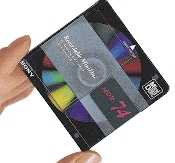
I think this will be my last piece on the whole portable audio thingy, at least for a while. I just needed to give a nod to probably my favorite media format, the MiniDisc... something that makes me weep at the lost potential due largely, IMO, to business decisions. A buddy who works at Sony helped me get my first one in Akihabara, one of the more amazing areas of Japan. I loved it and began recording stuff onto it while I was still there. It was smartly designed and became my preferred portable for a good long while. I even got a second one with the higher capacity some years later that was even smaller and cooler. And now I may never use them again. Accent on the may. I'm fairly confident that they'll stay in production for a good while yet and they make nice recorders.
In some ways though, I'm kind of surprised that MDs are still around and that you can buy them still. I remember when they first came out as a replacement for cassettes back in the late 1980's/early 1990s. They were kind of a technological curiosity back then but pretty slick. Sadly, the competing technology of digital cassettes came out about the same time creating consumer confusion and probably a bunch of angry customers that bought some only to see it vanish. I was kind of boggled by the DCCs introduction since DAT tapes were around too. The MD had the advantage though due to random access ability. It was also a slick package and a good counterpart to the CD which had become the standard distribution method. It was small and robust and held a reasonable amount of data, something like 100MB back then and about 1GB now.
But jeez, here we have a nice, slick, good, and robust digital medium and they loaded it with artificial restrictions. First, and most tragically, they intentionally prevented it from being used in conjunction with a computer (well, until relatively recently). So instead we were stuck with these Zip Disks which stored about as much but were a whole lot bigger. MDs would have been the perfect replacement to the 3.5" floppy which we were also stuck with for much longer than we needed. A disc that could be used both for data and in portable music players could have taken the world by storm at that time. But here we have some bigshots thinking that they could prevent piracy by not allowing it to be used with computers.
So eventually with the coming of other players that you could connect to your computer, they had to bow to pressure and finally produce players that you could upload music to via USB. Of course, they had to put in even more artificial restrictions to piss people off:
- Firstly (referring to the NetMD that I got) they only allowed one way recording. You could not record something, say, live onto an MD and download it to your computer.
- Then you could only transfer music in their proprietary format over, and no data. There goes any possibility of a portable drive.
- As for the music, you had to use their substandard and buggy program to do the transferring and it had these limitations like only being able to transfer a song to 3 discs at a time. There were workarounds of course.
So MDs did (and do?) thrive a bit more in Japan. I'm convinced that part of the reason is that they also used the MDs for more things. Over there you could get video cameras that recorded to it. Related Magneto-Optical storage for computers was also fairly widely used there unlike here. But now there are as-cool or cooler and more useful things available. And now, for me, I think it's just past the point of my willingness to upgrade to the latest Hi-MD. I sorely wanted one at one point but I waited just a hair too long and they stopped making the ones that took standard alkaline batteries. One AA would last me a good 24 hours or more of continuous play. The rechargeable ones didn't. Still, I was close. But I think I was abused as a consumer just once too often to trust them. Yes, the Hi-MD does have the fewest restrictions so far but there are still annoying ones there. Most pertinently, it won't let me transfer recorded music on my older MDs back to my computer digitally. Artificial restrictions. Fooey.
So... sorry Scregman. I know I was your partner in crime for these things. I'm still a fan. But I'm out. And I'm sure you can understand.
2006-01-23
Air Mailed
A partial order from Amazon came in today in a box capable of encasing 2 or 3 medical textbooks yet contained only one item which was slightly larger than a box of matches. The rest of the box was filled with bags of air. A month ago I received a box the size of a small footlocker. It contained more of these bags of air and a smaller yet still large box. This inside box was filled with crumpled paper and finally what amounted to be a set of headphones (gift from ifsatg). I have many other examples of items shipped in boxes 3 to 300 times the size necessary to contain said item. Not only does this violate my sensibilities regarding efficiency, waste, and ease of carrying, but I have a fear they're charging me more for shipping me air.

After a moments thought I wondered if the lunacy had rationale. Perhaps they just only stock certain box sizes and then make due. Nah, I have counterexamples. Then it dawned on me. They probably HAVE to ship items in large boxes to accommodate the bags of air. Some treehugger manager probably lobbied against the use of foam peanuts which are much more adaptable for packing things in smaller boxes. But the bags of air can't be fitted into the smaller, more appropriately sized boxes. Hence the overkill. This is all conjecture, I have no intention of researching nor inquiring about their shipping practices. Books thankfully are shipped plastic wrapped to a piece of cardboard and hence can be are sent in more fitted boxes.
Related anxiety
With all of the moving I've done (on average once every 1.5 to 2 years for the past 20 years) I have an ingrained propensity to keep and store every box that comes my way. This is bad. I really don't have room for all of these boxes. I often break down the larger ones at least to flat store them. But then there are the boxes with the enclosed foam casings for appliances, equipment, computer peripherals, etc. These I practically treat as sacrosanct. When I move again I want to pack these things properly. Yet all they do is take up space and serve no intermediate function. It's as if I need storage space to store storage space. Blimey! And I know the minute I swallow my frustration and rid myself of all this cardboard I'll need it. Murphy is always waiting just around the corner.

After a moments thought I wondered if the lunacy had rationale. Perhaps they just only stock certain box sizes and then make due. Nah, I have counterexamples. Then it dawned on me. They probably HAVE to ship items in large boxes to accommodate the bags of air. Some treehugger manager probably lobbied against the use of foam peanuts which are much more adaptable for packing things in smaller boxes. But the bags of air can't be fitted into the smaller, more appropriately sized boxes. Hence the overkill. This is all conjecture, I have no intention of researching nor inquiring about their shipping practices. Books thankfully are shipped plastic wrapped to a piece of cardboard and hence can be are sent in more fitted boxes.
Related anxiety
With all of the moving I've done (on average once every 1.5 to 2 years for the past 20 years) I have an ingrained propensity to keep and store every box that comes my way. This is bad. I really don't have room for all of these boxes. I often break down the larger ones at least to flat store them. But then there are the boxes with the enclosed foam casings for appliances, equipment, computer peripherals, etc. These I practically treat as sacrosanct. When I move again I want to pack these things properly. Yet all they do is take up space and serve no intermediate function. It's as if I need storage space to store storage space. Blimey! And I know the minute I swallow my frustration and rid myself of all this cardboard I'll need it. Murphy is always waiting just around the corner.
2005-11-21
My solution to CD piracy
Make CDs $5 retail. No, not $10, not $7... $5. There. Right now, I only buy a handful of CDs a year. I have to be pretty sure I like most of the album before I fork out $15-$20. It's too prohibitive to do that upon only hearing or liking 1 song. Ok, sometimes I am caught in that adventurous mood but I usually end up regretting it. Now, if CDs were $5 I'd go out and by 5 tomorrow, probably on the order of 10 a month on average. Those recording folk would get much much more of my money than what I spend now. I'd be much more willing to experiment and that would give some support to a wider number of artists. I get frustrated knowing there's a LOT of music out there that I know I'd love but haven't heard of or heard enough of. Does $5 cut into the industry profit margins? On the surface yes but I believe they'd more than make up for it in volume. E.g. I think that if they cut the standard price by a factor of 4, they would MORE than quadruple their sales. People like me wouldn't hesitate to buy some old favorites or check out new bands or even re-purchase the stuff that we already bought on vinyl or cassette.
I'm no economist but I actually think a quadruple in sales is a conservative estimate. I think the increase would be more than that since I believe they'd recoup most of the money that gets "lost" to piracy. A $5 price-point would eliminate most of the incentive to buy a cheap $2-$3 knock-off from the street vendor with the photo-copied cover; when for a couple dollars more they could get a legit copy with the complete liner notes and possibly the special packaging. Makes sense to me. They wouldn't really need to muck about with all those dubious schemes of copy-protection/virus-infection, making incompatible CDs, CDs that degrade after X number of plays, etc. (I think all of those attempts are futile to begin with.)
When CDs first came out, they were at around $18. Now that they're dirt cheap to make they're still sitting at around that price. Yeh, I know some marketing research dweeb ran through some statistical models and decided that $15-$20 (gotta include the tax) was the most people would be willing to pay and give the companies the highest yield, especially when it's the young folk who buy most of the music and I suspect often times regardless of cost due to peer pressure or parental subsidy. I submit, that that's the wrong approach. The unreasonably high cost creates a ripe market for unscrupulous people to produce dirt cheap copies and sell them for a couple bucks. They claim to be loosing millions, nay... billions, to pirates (Psshaaw, according to their artificial price).
A former coworker of mine once countered "yeh, but no-one who really collects music pays that full price anyways" in reference to used CD stores and CD clubs where they try to unload all of the older stuff or stuff that doesn't sell well at a "discount." Used CD stores are great, but the selection can sometimes be troublesome. I find CD clubs a bit annoying, especially when they rely on sending you things if you fail to return the little slip in time. Plus you're not going to find the newest stuff in those clubs. You'd also have to join several different clubs to begin with because each club represents a different set of labels.
Ok, I will admit that this idea and topic may be all but moot. This is of course due to the relatively new phenomena of online distribution. With Napster I think everyone realized this was the wave of the future, as I certainly did (in ref. to the online distribution, not the piracy, or perhaps that too). Of course the music industry shut Napster down, clinging to their outdated business models, but eventually they found a way to capitalize on it a la iTunes and similar. For the most part I think they have made good on a good idea. I can at least buy individual songs and have it quickly and effortlessly. The price is unfortunately twice what I think it should be and predictably the RIAA is currently insisting that the price be increased for the popular songs or risk loosing their catalog. (Bleh!) Then there are the digital rights management schemes that are also inconvenient, but that's another topic. Overall, though, I'll give this avenue a little more support simply due to the increased flexibility, efficiency, and convenience.
Still, even though there may come a day I may never buy a packaged CD again or perhaps store-bought CD's will become a thing of the past, I still think so long as pirated CDs are being sold that my solution has some merit. With the internet the RIAA has no hope of eliminating unauthorized distribution and I almost think it's a wasted effort. But with knock-off street-vendors, who are actually selling discs for money (rather than making copies and throwing them out there for all to obtain for free) , I'm fairly confident that this would put a big dent in their viability. With low-priced CDs the industry may even begin to stop treating their customers like criminals as they see their legitimate sales increase.
I'm no economist but I actually think a quadruple in sales is a conservative estimate. I think the increase would be more than that since I believe they'd recoup most of the money that gets "lost" to piracy. A $5 price-point would eliminate most of the incentive to buy a cheap $2-$3 knock-off from the street vendor with the photo-copied cover; when for a couple dollars more they could get a legit copy with the complete liner notes and possibly the special packaging. Makes sense to me. They wouldn't really need to muck about with all those dubious schemes of copy-protection/virus-infection, making incompatible CDs, CDs that degrade after X number of plays, etc. (I think all of those attempts are futile to begin with.)
When CDs first came out, they were at around $18. Now that they're dirt cheap to make they're still sitting at around that price. Yeh, I know some marketing research dweeb ran through some statistical models and decided that $15-$20 (gotta include the tax) was the most people would be willing to pay and give the companies the highest yield, especially when it's the young folk who buy most of the music and I suspect often times regardless of cost due to peer pressure or parental subsidy. I submit, that that's the wrong approach. The unreasonably high cost creates a ripe market for unscrupulous people to produce dirt cheap copies and sell them for a couple bucks. They claim to be loosing millions, nay... billions, to pirates (Psshaaw, according to their artificial price).
A former coworker of mine once countered "yeh, but no-one who really collects music pays that full price anyways" in reference to used CD stores and CD clubs where they try to unload all of the older stuff or stuff that doesn't sell well at a "discount." Used CD stores are great, but the selection can sometimes be troublesome. I find CD clubs a bit annoying, especially when they rely on sending you things if you fail to return the little slip in time. Plus you're not going to find the newest stuff in those clubs. You'd also have to join several different clubs to begin with because each club represents a different set of labels.
Ok, I will admit that this idea and topic may be all but moot. This is of course due to the relatively new phenomena of online distribution. With Napster I think everyone realized this was the wave of the future, as I certainly did (in ref. to the online distribution, not the piracy, or perhaps that too). Of course the music industry shut Napster down, clinging to their outdated business models, but eventually they found a way to capitalize on it a la iTunes and similar. For the most part I think they have made good on a good idea. I can at least buy individual songs and have it quickly and effortlessly. The price is unfortunately twice what I think it should be and predictably the RIAA is currently insisting that the price be increased for the popular songs or risk loosing their catalog. (Bleh!) Then there are the digital rights management schemes that are also inconvenient, but that's another topic. Overall, though, I'll give this avenue a little more support simply due to the increased flexibility, efficiency, and convenience.
Still, even though there may come a day I may never buy a packaged CD again or perhaps store-bought CD's will become a thing of the past, I still think so long as pirated CDs are being sold that my solution has some merit. With the internet the RIAA has no hope of eliminating unauthorized distribution and I almost think it's a wasted effort. But with knock-off street-vendors, who are actually selling discs for money (rather than making copies and throwing them out there for all to obtain for free) , I'm fairly confident that this would put a big dent in their viability. With low-priced CDs the industry may even begin to stop treating their customers like criminals as they see their legitimate sales increase.
2005-11-17
Transformer overload
I'm not sure at the moment of what the solution is to the ever increasing entropy surrounding the growing presence of rats nests of cables, wires, and power cords, but one place I'd start is with the powerstrip plugs and transformers. Every little consumer device now seems to need to be plugged in. These things invariably run on DC and hence require a transformer. Transformers are usually not placed within the device itself. Instead it's a big, sometimes weighty, box you have to plug into the wall or powerstrip socket. When you have several of these things there's just no room to plug them all in. You have to get special spacious power strips that grant room for multiple transformers or perphaps even specialty items. In most cases you end up with a bulk of cords, plugs, and transformers clumped up on the floor or on the wall.
Well, there's a large class of devices out there that are typically small, require only 12 volts of DC or less, and don't need the amperage of a vacuum cleaner. Such devices typically come with their own power transformer with a little mini-jack looking plug that cleanly slides into the device. It is the little mini-jack that is of interest to me. Wouldn't it be nice if along with the ubiquitous 2-3 pronged wall socket, there were DC power strips of these little mini-jacks. No need for 5-10 big transformers elbowing each other for space, just a simple little box with an array of mini-jacks supplying modest transformed electricity to the devices via simple non-bulky cords.
Basically, leave the pronged wall sockets to the big hungry power consuming items like TVs, vacuums, kitchen appliances, and such; but make a second standard set of more numerous socket arrays for the smaller and power modest devices like cordless phones, ethernet routers, portable music players, mobile phones, low power vanity or ambiance lights, electric razors, etc. etc. etc. Of course they'd all need to standardize on the same mini-plug jack (never understood why there are so many pitches to these things, ever see those Radio Shack adaptors with the 20 differently sized tips?) and perhaps even the same output voltage. Heck if it were truly standard, only one type of power cord would be needed, they'd be available anywhere, and you may not even need more than a few.
I just imagine a only-very-slightly more convenient world where I do not need to carry around bulky transformers for all of my portable devices on trips or I didn't have to plug my phone in the far room with the free wall socket. Yes a ubiquitous standard would be nice. But as the oxymoronical saying goes "the good thing about standards is there are so many of them."
Well, there's a large class of devices out there that are typically small, require only 12 volts of DC or less, and don't need the amperage of a vacuum cleaner. Such devices typically come with their own power transformer with a little mini-jack looking plug that cleanly slides into the device. It is the little mini-jack that is of interest to me. Wouldn't it be nice if along with the ubiquitous 2-3 pronged wall socket, there were DC power strips of these little mini-jacks. No need for 5-10 big transformers elbowing each other for space, just a simple little box with an array of mini-jacks supplying modest transformed electricity to the devices via simple non-bulky cords.
Basically, leave the pronged wall sockets to the big hungry power consuming items like TVs, vacuums, kitchen appliances, and such; but make a second standard set of more numerous socket arrays for the smaller and power modest devices like cordless phones, ethernet routers, portable music players, mobile phones, low power vanity or ambiance lights, electric razors, etc. etc. etc. Of course they'd all need to standardize on the same mini-plug jack (never understood why there are so many pitches to these things, ever see those Radio Shack adaptors with the 20 differently sized tips?) and perhaps even the same output voltage. Heck if it were truly standard, only one type of power cord would be needed, they'd be available anywhere, and you may not even need more than a few.
I just imagine a only-very-slightly more convenient world where I do not need to carry around bulky transformers for all of my portable devices on trips or I didn't have to plug my phone in the far room with the free wall socket. Yes a ubiquitous standard would be nice. But as the oxymoronical saying goes "the good thing about standards is there are so many of them."
2005-11-16
What about Sony?
I find it mildly ironic that with the introduction of the Walkman Sony had started what I consider to be the "free YOUR music" movement, or maybe the weaker "take YOUR music with you" movement. Now they're more of a "we'll tell you what you can do with OUR music" company. There's a lot of rows on their recent sinister stealth inclusion of copy protection that messes with your computer. I speculate the new philosophy started when they built up their recording and movie divisions.
For me I noticed the trend coming when I started using MiniDiscs. I love those little things (future rave alert). I bought my first portable recorder while on a visit to Japan, in Akihabara, the most incredible and insane consumer electronics area on the planet. It was more of a tape repacement but a sweet one. MP3 players started coming out though and (eventually, ugh!) they got with the program and made a computer connectable series; something that should make sense in the first place since it's a digital media. So I got one of those net-enabled ones and, alas, they intentionally crippled it. You couldn't download stuff you recorded onto it digitally. You couldn't transfer a music file to more than three discs. You had to use their proprietary music format. And you couldn't store non-music files on it, a shame for any type of digital media.
Now they've gone one step further and surreptitiously added stuff to their new CDs that would load and hide itself on your computer, in an effort to prevent you from having illegal music, and without apology. Turns out the technology makes your computer insecure as well. They also cooked up an inane scheme to bind playstation games to a specific console, making them unplayable on other consoles (even the 2nd one you bought because the first one broke), or lend or rent them out. Egads!
Sony was a cool company. This together with how they manage customer service in their online games division, however, makes me want to say phooey to them. Luckily I don't buy many CDs anymore (future rant alert) and know to steer clear of theirs.
For me I noticed the trend coming when I started using MiniDiscs. I love those little things (future rave alert). I bought my first portable recorder while on a visit to Japan, in Akihabara, the most incredible and insane consumer electronics area on the planet. It was more of a tape repacement but a sweet one. MP3 players started coming out though and (eventually, ugh!) they got with the program and made a computer connectable series; something that should make sense in the first place since it's a digital media. So I got one of those net-enabled ones and, alas, they intentionally crippled it. You couldn't download stuff you recorded onto it digitally. You couldn't transfer a music file to more than three discs. You had to use their proprietary music format. And you couldn't store non-music files on it, a shame for any type of digital media.
Now they've gone one step further and surreptitiously added stuff to their new CDs that would load and hide itself on your computer, in an effort to prevent you from having illegal music, and without apology. Turns out the technology makes your computer insecure as well. They also cooked up an inane scheme to bind playstation games to a specific console, making them unplayable on other consoles (even the 2nd one you bought because the first one broke), or lend or rent them out. Egads!
Sony was a cool company. This together with how they manage customer service in their online games division, however, makes me want to say phooey to them. Luckily I don't buy many CDs anymore (future rant alert) and know to steer clear of theirs.
2005-11-02
Flat Woe #4
So I figure I may as well generate my LAST post on the topic of my gripes with my flat (as if my masculinity was not already irreparably damaged). This is something that came up again when I was hanging out front with one of my first floor neighbors on Monday. She was talking about possibly having another party sometime between now and the end of the year; she and her roommate had one a couple months ago which was quite fun. Their flat is perfect for having parties. It has two common areas separated by double sliding doors that connect them into one large open space. Perfect for holding a nice amount of people as well as modest furnishings. And to boot, the connecting kitchen is right in line and also quite spacious. The second floor has virtually the same layout, wide connecting common areas with kitchen and two smallish but adequate rooms. The only difference is the location of the bathroom.
My flat SHOULD have had the same general floorplans as the bottom two floors. The only potential obstructions are some pillars that must go through due to the downstairs chimneys. However, the locations of these things would not have interfered too much since, when you think about it logically, the actual floor area should be a perfect match as we share all the walls and the flats are right on top of each other. Instead, and in addition to the absolutely ridiculous walls added to seal off the slants in the ceiling, they re-arranged the locations of the rooms in a dreadful configuration. I don't have the nice large connected common areas, they are separated into completely individual rooms, one being a bedroom, the other being a bedroom OR a living room. The kitchen, instead of being in the back is on the side, not enclosed, and away from back stairwell door. This creates an awkward L-shaped living area joined with the kitchen, with a hide-the-slant-closet at the joint. The back door is the piece de resistance: A mini corridor with a door connecting to the back stairwell juts out into the small living-room-ish space creating two awkward alcoves. Trust me, it's worse to see than what I describe. If at least the kitchen were in the back, those alcoves could have served as pantries or one of them as a kitchenette and the side of the house could have been a nice functional open area appropriate for creature comforts and guests. Right now I'm almost embarrassed about the layout (even too ashamed to post a pic). I don't have many guests, much less a party. Of course I'm more embarrassed that I'm actually bugged about this. But maybe one of the good folks from TLC will see this and take pity.
My flat SHOULD have had the same general floorplans as the bottom two floors. The only potential obstructions are some pillars that must go through due to the downstairs chimneys. However, the locations of these things would not have interfered too much since, when you think about it logically, the actual floor area should be a perfect match as we share all the walls and the flats are right on top of each other. Instead, and in addition to the absolutely ridiculous walls added to seal off the slants in the ceiling, they re-arranged the locations of the rooms in a dreadful configuration. I don't have the nice large connected common areas, they are separated into completely individual rooms, one being a bedroom, the other being a bedroom OR a living room. The kitchen, instead of being in the back is on the side, not enclosed, and away from back stairwell door. This creates an awkward L-shaped living area joined with the kitchen, with a hide-the-slant-closet at the joint. The back door is the piece de resistance: A mini corridor with a door connecting to the back stairwell juts out into the small living-room-ish space creating two awkward alcoves. Trust me, it's worse to see than what I describe. If at least the kitchen were in the back, those alcoves could have served as pantries or one of them as a kitchenette and the side of the house could have been a nice functional open area appropriate for creature comforts and guests. Right now I'm almost embarrassed about the layout (even too ashamed to post a pic). I don't have many guests, much less a party. Of course I'm more embarrassed that I'm actually bugged about this. But maybe one of the good folks from TLC will see this and take pity.
2005-10-28
On car stereos and portables
About 2 years ago I finally decided to replace the factory default stereo that came with my car (and broke twice). It was a cassete-deck one and I decided to upgrade to a CD player model that played MP3 CDs (11 albums on a burnt CD is nice). However, I knew then (and for a long while before that) what I really wanted was a stereo that had a convenient mini-plug auxiliary line-in. At the time I had a Nomad MP3 player that I would use on long trips. I had to use that annoying cassette adapter up until I got the replacement. I searched high and low at the various consumer electronics stores and eventually only found about 3 models that had that nice, simple, convenient feature. Two were no-named ones and at last I found a nicely inexpensive AIWA that I purchased and am quite satisfied with. I retired my Nomad and sufficed on a collection of burnt MP3 CDs for the most part. My recent acquisition of an iPod Nano (I'll defend that surprising decision some other time) has made me re-appreciate that firm requirement I had for my car stereo from back then. A simple mini-plug cable connects it to my stereo so I can listen to whatever music/podcast/audiobook continuously.
I wonder though. Was there some devious intent behind the lack of convenient auxiliary line-in jacks on the face of car stereos? Or were the makers really just clueless? When I was a wee lad the typical car stereo was a radio and tape deck. That's still largely true, they often make you get the CD-player option for extra money at the car dealerships. Anyhow, back then, very occasionally you'd see an 8-track deck but those were well past obsolete. The Walkman just came out to change the landscape of consumer electronics, but it was also just a tape player. No need for an auxiliary input since your car stereo played the same media. No problem. Then CDs came out, soon to be followed by the CD car stereo and the CD Walkman. Cassettes, however, were still a predominant listening choice though because you couldn't easily record CDs and make your own mix-tapes, what they now call playlists. So, if you had a CD stereo you couldn't play your tapes (unless you got the dual deck) and vice versa. This would have been a good time to make decks with a mini-plug line-in so you could play stuff on your Walkman in your car. Did they? No. You had to buy one of those hokey cassette adapters. Later, they came up with local FM transmitters. That was the best they could do? Both solutions degrade the quality, are failure prone, and are not as clean and efficient as a simple mini-plug cable connecting the headphone jack on your portable and the car stereo.
After the CD Walkman other forms of portable media emerged: first the MiniDisc and Digital Cassette came (and went), and later the portable MP3 players became all the rage. And you still had to loose quality of playback in your car via the transmitter or introduce a hum with the cassette adapter. I didn't like that. I remember having several copies of the same music on cassette, CD, MiniDisc, and MP3 in order to accommodate the different playing environments. I'm sure many can relate.
It took the introduction and mass popularity of the iPod to finally stir some movement, even though other MP3 players and similar had been in vogue for years. Now, finally, car stereos with a mini-plug on the front dash appeared. Not en masse, but at least there were a few. When I was looking for a stereo with just that feature 2 years ago some big-named makers required a pricey kit and an installed wire from the back of the stereo. Boggle. If they can put a laser, mechanics, and fancy displays in the stereo, then they can trivially put in an extra mini-plug input to accommodate portable players. It's not that obtrusive and it doesn't interfere with any other stereo features and people don't have to use it they don't want to. So why did it take them so long to get with the program and why is it still not a standard option? I sense a combination of maniacal consumer control conspiracy coupled with abject ignorance and ignoramousy.
I wonder though. Was there some devious intent behind the lack of convenient auxiliary line-in jacks on the face of car stereos? Or were the makers really just clueless? When I was a wee lad the typical car stereo was a radio and tape deck. That's still largely true, they often make you get the CD-player option for extra money at the car dealerships. Anyhow, back then, very occasionally you'd see an 8-track deck but those were well past obsolete. The Walkman just came out to change the landscape of consumer electronics, but it was also just a tape player. No need for an auxiliary input since your car stereo played the same media. No problem. Then CDs came out, soon to be followed by the CD car stereo and the CD Walkman. Cassettes, however, were still a predominant listening choice though because you couldn't easily record CDs and make your own mix-tapes, what they now call playlists. So, if you had a CD stereo you couldn't play your tapes (unless you got the dual deck) and vice versa. This would have been a good time to make decks with a mini-plug line-in so you could play stuff on your Walkman in your car. Did they? No. You had to buy one of those hokey cassette adapters. Later, they came up with local FM transmitters. That was the best they could do? Both solutions degrade the quality, are failure prone, and are not as clean and efficient as a simple mini-plug cable connecting the headphone jack on your portable and the car stereo.
After the CD Walkman other forms of portable media emerged: first the MiniDisc and Digital Cassette came (and went), and later the portable MP3 players became all the rage. And you still had to loose quality of playback in your car via the transmitter or introduce a hum with the cassette adapter. I didn't like that. I remember having several copies of the same music on cassette, CD, MiniDisc, and MP3 in order to accommodate the different playing environments. I'm sure many can relate.
It took the introduction and mass popularity of the iPod to finally stir some movement, even though other MP3 players and similar had been in vogue for years. Now, finally, car stereos with a mini-plug on the front dash appeared. Not en masse, but at least there were a few. When I was looking for a stereo with just that feature 2 years ago some big-named makers required a pricey kit and an installed wire from the back of the stereo. Boggle. If they can put a laser, mechanics, and fancy displays in the stereo, then they can trivially put in an extra mini-plug input to accommodate portable players. It's not that obtrusive and it doesn't interfere with any other stereo features and people don't have to use it they don't want to. So why did it take them so long to get with the program and why is it still not a standard option? I sense a combination of maniacal consumer control conspiracy coupled with abject ignorance and ignoramousy.
2005-10-23
Flat woe #2 and #3
Many of the houses out here in NE, and in fact pretty much everywhere, have slanted roofs. I think they tend to be a bit more slanted in places that have snowfall. Makes sense. Don't want to have snow accumulating up there too much. The upshot of this is many of the top floor flats in such houses have slanted walls. I actually think this is fine and adds a little charm to a place.
... except in my case. Somewhere down the line someone decided they didn't like slanted walls and so they decided to reduce the usable space of this flat by adding walls whose sole purpose was to hide said slanted walls. This causes a strange sense of boxing within my flat as yet more walls and vertices were placed within. It seals the place in a bit and I prefer the more open area, even with the slanted walls. It at least would give more usable floor space.
Someone must have thought about that just a little too, because in addition to sealing off the slanted walls they opted to add closet doors to these walls. Well one of them didn't have doors but rather a waist-high opening. (I find this one the most puzzling and the most unsightly of all. I just don't get it.) These closets are barely usable. You cannot stack much in the way of boxes in them due to the irregular shape. You definitely can't hang clothes in there. It simply is a cosmetic thing to make it look like you have a closet when if fact you really don't. And it unnecessarily clutters the look of the space.
Which leads to my next woe which is actually the main woe of this post: lack of functional closets. Every once in a while I get way behind on my laundry and I end up doing nearly the whole of my functional wardrobe in a single day, such as yesterday. There is only one closet in this flat worthy of being called a closet, and one which is more of a coat closet that I use as a main closet due to its location. It's rather small. After doing most of my laundry I realised once again that I do not have enough closet space to hang all of my garments.
If this were mine to remodel, I'd knock down all of those shameful walls and even what closets there were. I'd much rather get a nice set of armoire's in an open room. Can't rightly do that now due to the presense of the walls and pseudo-closets since they'd subtract too much additional room space. I surprise myself a little thinking about such things as apartment aesthetics but in this case the complaints are rooted in functionality and I feel justified.
But alas, there's nothing I can do about it other than maybe make another round of clothing donations.
... except in my case. Somewhere down the line someone decided they didn't like slanted walls and so they decided to reduce the usable space of this flat by adding walls whose sole purpose was to hide said slanted walls. This causes a strange sense of boxing within my flat as yet more walls and vertices were placed within. It seals the place in a bit and I prefer the more open area, even with the slanted walls. It at least would give more usable floor space.
Someone must have thought about that just a little too, because in addition to sealing off the slanted walls they opted to add closet doors to these walls. Well one of them didn't have doors but rather a waist-high opening. (I find this one the most puzzling and the most unsightly of all. I just don't get it.) These closets are barely usable. You cannot stack much in the way of boxes in them due to the irregular shape. You definitely can't hang clothes in there. It simply is a cosmetic thing to make it look like you have a closet when if fact you really don't. And it unnecessarily clutters the look of the space.
Which leads to my next woe which is actually the main woe of this post: lack of functional closets. Every once in a while I get way behind on my laundry and I end up doing nearly the whole of my functional wardrobe in a single day, such as yesterday. There is only one closet in this flat worthy of being called a closet, and one which is more of a coat closet that I use as a main closet due to its location. It's rather small. After doing most of my laundry I realised once again that I do not have enough closet space to hang all of my garments.
If this were mine to remodel, I'd knock down all of those shameful walls and even what closets there were. I'd much rather get a nice set of armoire's in an open room. Can't rightly do that now due to the presense of the walls and pseudo-closets since they'd subtract too much additional room space. I surprise myself a little thinking about such things as apartment aesthetics but in this case the complaints are rooted in functionality and I feel justified.
But alas, there's nothing I can do about it other than maybe make another round of clothing donations.
Subscribe to:
Posts (Atom)